
An ISMS (information security management system) according to ISO 27001 gives information security in a company a structure. Building one covers risk analysis, security policies, controls, training and audits. The goal is effective protection of sensitive data, compliance with legal requirements and a demonstrable competitive advantage through certified information security. Realistically, setup and implementation take 3 to 9 months until you are ready for certification. If you want support along the way: our ISO 27001 consulting takes you to the audit at a fixed price.
Introduction to the terms
What is an ISMS?
An information security management system (ISMS) is a framework of rules, processes and responsibilities for the systematic management of a company's information security.
It defines processes, responsibilities and technical as well as organizational measures to ensure the confidentiality, integrity and availability of business-critical information.
An ISMS is a central part of the company-wide security strategy and forms the basis for lasting cyber resilience.
Legal and normative context (e.g. ISO/IEC 27001, BSI IT-Grundschutz)
The international standard ISO/IEC 27001 describes the requirements for an effective ISMS. It specifies how organizations identify, assess and control risks.
The BSI IT-Grundschutz (IT baseline protection of the German Federal Office for Information Security) supplements the ISO standard with practice-oriented security modules for German companies. Combining both approaches provides a solid foundation for compliance and audit readiness.
Benefits and objectives of an ISMS
Protection requirements: confidentiality, integrity, availability
An ISMS protects sensitive company assets – from production data and supplier data to intellectual property.
Clearly defined security objectives make it possible to prevent cyberattacks, data leaks and system failures in a targeted way. Companies can prioritize risks and deploy resources where the security impact is greatest.
Added value for organizations (compliance, risk management, competition)
Implementing an ISMS delivers measurable added value:
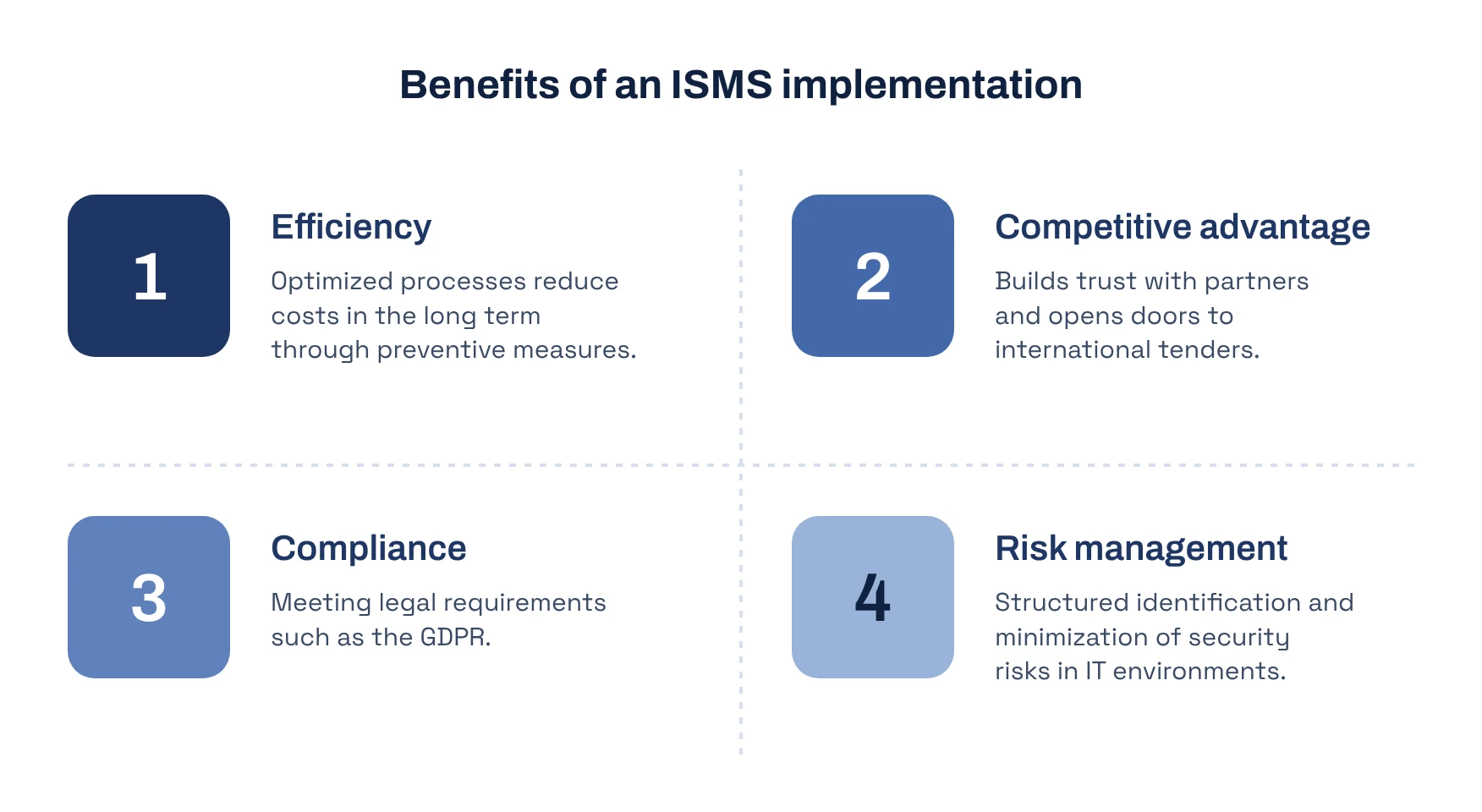
- Compliance: Support with legal requirements such as the GDPR and NIS-2 (in force in Germany since 6 December 2025 through the NIS2UmsuCG).
- Risk management: Structured identification and minimization of security risks in IT and production environments.
- Competitive advantage: An ISO 27001 certification strengthens trust among partners (in German) and opens doors to international tenders
- Efficiency: Optimized processes reduce costs in the long term through preventive measures instead of damage repair.
How is ISO 27001 structured?
The standard has two parts: clauses 4 to 10 set out the requirements for the management system – context, leadership, planning, support, operation, evaluation and improvement. Annex A contains 93 controls in four themes (organizational, people, physical, technological), from which you select based on your risk assessment. This structure also determines the order in which you build the ISMS.
Framework conditions for building an ISMS
Analysis of the organization and its context
A precise context analysis is the starting point of every ISMS. It analyzes business processes, the system landscape and threat scenarios. Especially in an Industry 4.0 environment with connected machines, transparency is crucial to identify vulnerabilities early.
Leadership and governance
The success of an ISMS depends heavily on management commitment and clear governance. Top management defines security objectives, provides resources and anchors information security in the corporate strategy. This creates a holistic security approach with top-down responsibility.
Project organization and stakeholders
A cross-functional project team from IT, production, compliance and HR ensures that security measures remain practicable.
External ISMS consultants with industry knowledge can make up for missing know-how, speed up processes and reduce cost risks.
If you do not want to take these steps alone, you can get support with building your ISMS from scope definition to the internal audit.
Step-by-step approach to building an ISMS
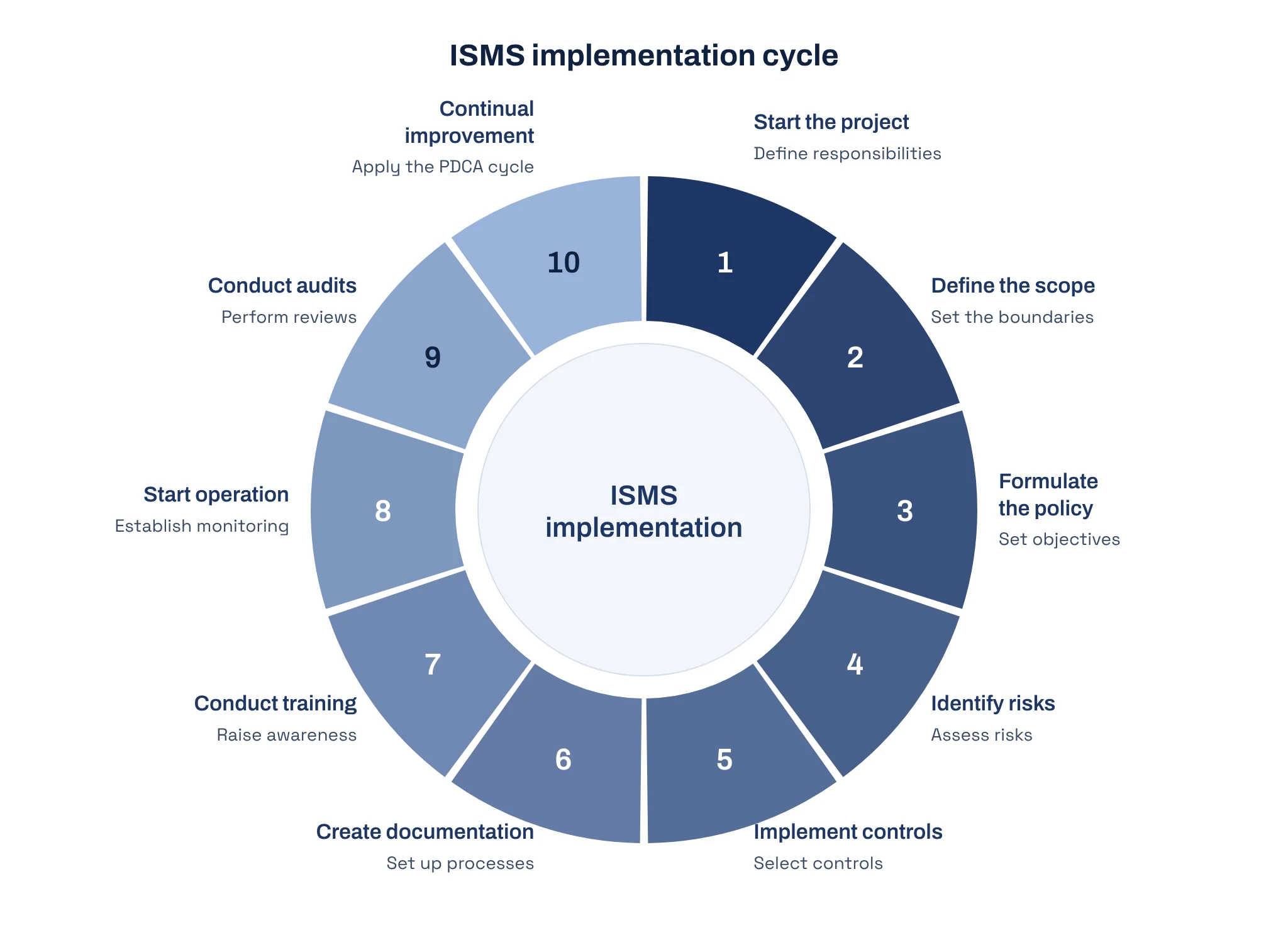
1. Start the project and assign responsibilities
First, the scope, roles and responsibilities are defined. An information security officer (ISO) coordinates all ISMS activities and acts as the central interface between management and operational teams.
The responsibilities of the ISO range from risk analysis to reporting. If you cannot fill the role internally, you can appoint an external information security officer (in German) — without any onboarding time.
2. Define the scope
This step determines which sites, systems and data sets the ISMS covers. A clear boundary makes later reviews by auditors easier and avoids unnecessary complexity.
3. Formulate the information security policy and objectives
The security policy defines the company's values in handling information.
It must be understandable, binding and linked to the company's objectives – such as increased efficiency, data protection and customer satisfaction.
4. Risk identification, assessment and treatment
Risk assessment and treatment are the heart of ISO 27001.
Threats such as cyberattacks, ransomware, supplier failures or human error are identified, assessed and treated with suitable protective measures (controls).
The result is a documented risk treatment plan that sets priorities and assigns tasks.
5. Select and implement controls (e.g. Annex A, IT-Grundschutz modules)
The selection of controls is based on ISO 27001 Annex A or the BSI modules. Examples:
- Access control and authorization management
- Network protection and firewalls
- Encryption technologies
- Backup and recovery procedures
This creates a security level that covers both technical and organizational risks.
6. Set up documentation, processes and procedures
All measures must be documented in a traceable way – from risk analyses to training results.
Good document control ensures audit readiness and supports continual improvement.
7. Training, awareness and internal communication
People are the most important factor in information security.
Targeted awareness programs and training promote security awareness and strengthen the security culture in the company.
8. Start operation, establish monitoring and metrics
After implementation, the operational phase begins.
Key performance indicators (KPIs) – such as security incidents, audit nonconformities or response times – are used to measure the effectiveness of the ISMS.
9. Internal audits and management review
Regular reviews ensure the effectiveness of the measures.
In the management review, results are evaluated and improvement measures are decided – the basis for lasting compliance.
10. Continual improvement (PDCA cycle)
The ISMS follows the PDCA principle (Plan-Do-Check-Act).
It ensures that security measures are continuously reviewed, adapted and optimized – especially in the event of technological or regulatory changes.
Integration and operation
Embedding the ISMS in business and IT processes
An effective ISMS only works if it becomes part of day-to-day operational processes.
Security policies must be integrated in a practical way so that production, engineering and IT systems run smoothly.
Interfaces to all areas (e.g. supply chain, third parties, cloud)
Suppliers, partners and cloud service providers are part of the information security ecosystem. Supply chain security and contractual policies secure information flows outside your own organization.
Technical and organizational measures in everyday operations
Ongoing security measures include:
- Multi-factor authentication
- Patch management
- Access policies
- Incident response processes
These increase cyber resilience and minimize operational downtime risks.
Certification and auditing
External audit stages and certification process
Certification according to ISO 27001 takes place in two stages:
- Document review (Stage 1) – assessment of the ISMS documentation.
- System audit (Stage 2) – review of implementation in practice.
A successful audit strengthens the trust of customers, authorities and business partners.
Evidence, SoA (Statement of Applicability) and documentation
The Statement of Applicability (SoA) documents which controls have been implemented and how they address the identified risks.
This transparency creates traceability and demonstrates compliance to auditors.
According to the ISO Survey, there were around 1,600 valid ISO 27001 certificates in Germany at the end of 2022.
Different models: ISO/IEC 27001 and IT-Grundschutz
While ISO 27001 is internationally oriented, IT-Grundschutz offers practical guidance for German SMEs.
Applying both combines international acceptance with operational feasibility.
Success factors and pitfalls
Accountability and management support
Without active management commitment, information security remains ineffective.
Management support secures budget, resources and priority – essential for a sustainable ISMS.
Realistic processes, understandable documentation
Over-documentation and overly complex processes lead to rejection.
A clearly structured, practice-oriented system ensures acceptance and reduces sources of error.
Change management, employee involvement, awareness
Change management promotes the acceptance of security policies.
Employees are involved in decision-making processes to create a shared understanding of security.
Prevention as the key to success in the ISMS
A central success factor in implementing an ISMS according to ISO 27001 is the ability to prevent. Those who identify vulnerabilities early and secure them in a targeted way significantly reduce the attack surface for cyber threats.
This includes:
- Technical measures such as patch management and network security
- Organizational structures such as an effectively managed ISMS
- Human factors such as security awareness training and qualified IT staff
Without these preventive pillars, the ISMS remains vulnerable – despite formal certification. Prevention is therefore not only a requirement of the standard, but an integral part of a sustainable cybersecurity strategy[1].
Typical mistakes when building an ISMS
Missing risk analysis or prioritization
- Too little communication between IT and business departments
- Insufficient maintenance of documentation
- No regular review of security objectives
Future perspectives
Trends in information security (e.g. AI, cloud, hybrid environments)
Artificial intelligence, automation and cloud computing are shaping the information security of the future.
ISMS solutions must be scalable and data-driven in order to detect security events early.
New requirements from revisions of the standard
Regular updates to the ISO standards require a flexible system architecture. Most recently, Amendment 1 in 2024 added requirements on climate change; the transition period to the 2022 version ended on 31 October 2025.
Companies benefit from continuous training and internal knowledge management.
Sustainability and increasing the maturity of the ISMS
A mature ISMS grows with the company's requirements.
Long-term security objectives, benchmarks and regular audits promote sustainable information security and strengthen digital resilience.
Frequently asked questions about building an ISMS
What does it mean to build an ISMS according to ISO 27001?
Building an information security management system (ISMS) according to ISO 27001 covers the planning, implementation, monitoring and continual improvement of information security. This includes risk analyses, security policies, technical and organizational measures and regular audits to verify effectiveness.
Which steps are part of implementing an ISMS?
An ISMS is built in several phases:
- Define the scope and responsibilities
- Create the risk analysis and security policy
- Select and implement security controls
- Train employees and document processes
- Conduct internal audits and improve results
This structured approach corresponds to the PDCA cycle (Plan – Do – Check – Act).
Why is an ISMS important for industrial companies?
Industrial companies process confidential production, customer and development data. An ISMS protects this information against cyberattacks, sabotage or data loss. It also helps meet legal requirements (e.g. the GDPR) and builds trust with business partners – a decisive competitive advantage in tenders or supplier audits.
How long does it take to build an ISMS?
The duration depends on the size of the company, the existing IT structure and the available resources. In mid-sized industrial companies, introducing an ISMS usually takes 3 to 9 months until ISO 27001 certification can be completed.
What does developing an ISMS according to ISO 27001 cost?
Costs vary depending on scope, internal involvement and consulting effort.
External consulting for building an ISMS according to ISO 27001 is available from 360DT from €20,000 (fixed price after scoping). On top of this come the fees of the certification body according to its quotation, as well as internal effort for training and audit preparation.
In the long term, these investments pay for themselves through fewer security incidents and greater compliance certainty.
What are typical mistakes in the structure of an ISMS?
In our experience, typical mistakes are unclear responsibilities, a lack of management support, incomplete risk analyses or overly complex documentation.
A clear project plan, seminars and regular reviews prevent these mistakes and ensure a successful implementation.
How is an ISMS certified?
Certification takes place in two steps:
- Stage 1 (document review): assessment of the ISMS documentation and policies (only relevant for initial certification)
- Stage 2 (system audit): review of practical implementation in the company
After a successful audit, the company receives the ISO 27001 certificate, which is valid for three years and is subject to annual surveillance.
Can an ISMS be combined with existing management systems?
Yes. An ISMS integrates very well with existing systems such as ISO 9001 (quality management) or ISO 14001 (environmental management).
This reduces duplicate effort and enables a uniform, efficient management system for all areas of the company.
Sources used:
- BSI – The State of IT Security in Germany 2025 (in German)
About the Author

Can Adigüzel is co-founder and managing director of 360 Digitale Transformation GmbH, a consultant for TISAX® and ISO 27001 Lead Auditor with more than 200 audits. He has worked in IT project management since 2012 and in information security since 2019. He helps SMEs implement information security pragmatically.