
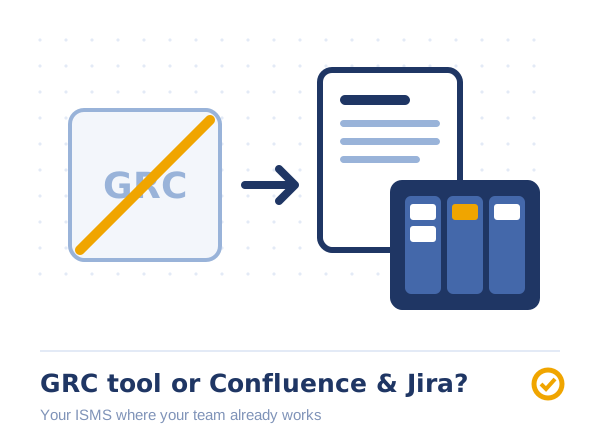
If you build an ISMS for ISO 27001, TISAX® or NIS-2, offers for GRC tools arrive quickly: software for governance, risk and compliance, licensed per user or per year. For many mid-sized companies, that is one more platform nobody opens in day-to-day work. If your team already works in Confluence and Jira, you have the key building blocks in-house.
What a GRC tool actually does
At its core, a GRC tool bundles four things:
- Documents: policies, processes and evidence in one place, with versions and approvals
- Registers: risks, assets, suppliers and the Statement of Applicability (SoA)
- Tasks: measures, corrective actions and incidents with owners, deadlines and status
- Overview: reports for management and the auditor
None of these is tied to a specific piece of software. The standards require documented information, traceable processes and evidence, not a particular tool.
What the standards require – and what they don't
ISO 27001 requires in clause 7.5 that documented information is controlled: identified, up to date, approved, protected and available. The VDA ISA for TISAX® asks for processes that are implemented and lived. NIS-2 requires risk management measures and reporting channels. None of these frameworks says a GRC tool is needed. In the audit, what counts is whether you can show what you do, who does it and since when.
How Confluence and Jira cover the requirements
| Requirement | GRC tool | Confluence & Jira |
|---|---|---|
| Policies and processes | Document module | Confluence pages with automatic versioning |
| Approvals and document control | Approval workflow | Page status, owner and document history on every page |
| Risk register and risk treatment | Risk module | Jira issues with workflow, rating and owner |
| Measures, corrective actions, incidents | Task module | Jira issue types with status, due dates and automation |
| Evidence for the audit | Export or auditor access | History of every page and issue; read access for the auditor |
| Overview for management | Dashboard | Jira dashboards and filters |
The decisive difference is not the feature, but the use: your team works in Confluence and Jira every day anyway. A risk, a change or an incident lands where the work happens. Evidence is created along the way instead of being collected after the fact before the audit.
The benefits in daily work
- No additional platform: no extra login, no separate training, no new interface.
- No additional licences: you use the Atlassian licences you already have.
- Your data stays in your instance: Cloud or Data Center, with your permissions and your backup.
- No lock-in: the content is your Confluence pages and Jira issues – even if you change something later.
- One structure for several standards: ISO 27001, TISAX® and NIS-2 overlap heavily; a shared structure avoids maintaining things twice.
When a GRC tool can still make sense
To be fair, there are cases where a GRC tool is the better choice:
- Your team does not use Confluence and Jira, or only in some departments.
- You manage many standards and legal entities at the same time and need group-wide reporting.
- You want technical evidence collected automatically from cloud services and systems, for example for SOC 2.
For a typical mid-sized company with an ISMS under ISO 27001 or TISAX®, this is rarely the case.
What you need to make it work
Confluence and Jira are empty when you start. An ISMS in them needs a well-designed structure: a page tree that follows the structure of an ISMS, policies with owner, classification and document history, Jira issue types for risks, measures, incidents and changes, and workflows with clear statuses. Developing this structure yourself takes time – and it is exactly where many projects stall.
Our ISMS templates for Confluence & Jira (page in German) provide this structure ready to use: policies, processes and Jira workflows for ISO 27001, TISAX® and NIS-2, imported into your own instance. If you also want support with building your ISMS, we start with a gap analysis.
View the ISMS templates Schedule a free initial consultation
Frequently asked questions
Does an auditor accept an ISMS in Confluence and Jira?
Yes. Auditors check whether the requirements are implemented and evidenced, not which tool you use. What matters is controlled documents, traceable changes and evidence – Confluence and Jira provide that.
Do I need special software for ISO 27001?
No. ISO 27001 does not prescribe any software. It requires documented information that is controlled and processes that are demonstrably implemented.
Does this work with Confluence Cloud and Data Center?
Yes. An ISMS can be built in both. Our templates are available for Cloud and Data Center.
What happens if we introduce a GRC tool later?
Your policies, registers and issues are stored in a structured way in Confluence and Jira and can be exported. The work on your ISMS is not lost.
About the author

Can Adigüzel is co-founder and managing director of 360 Digitale Transformation GmbH, a consultant for TISAX® and ISO 27001 Lead Auditor with more than 200 audits. He has worked in IT project management since 2012 and in information security since 2019. He helps SMEs implement information security pragmatically.
Confluence and Jira are trademarks of Atlassian. 360 Digitale Transformation GmbH has no business relationship with Atlassian. TISAX® is a registered trademark of the ENX Association. 360 Digitale Transformation GmbH has no business relationship with ENX. Mentioning the TISAX® trademark does not imply any statement by the trademark owner about the suitability of the services advertised here. TISAX® assessments for obtaining labels are carried out only by the audit providers listed on the ENX website.